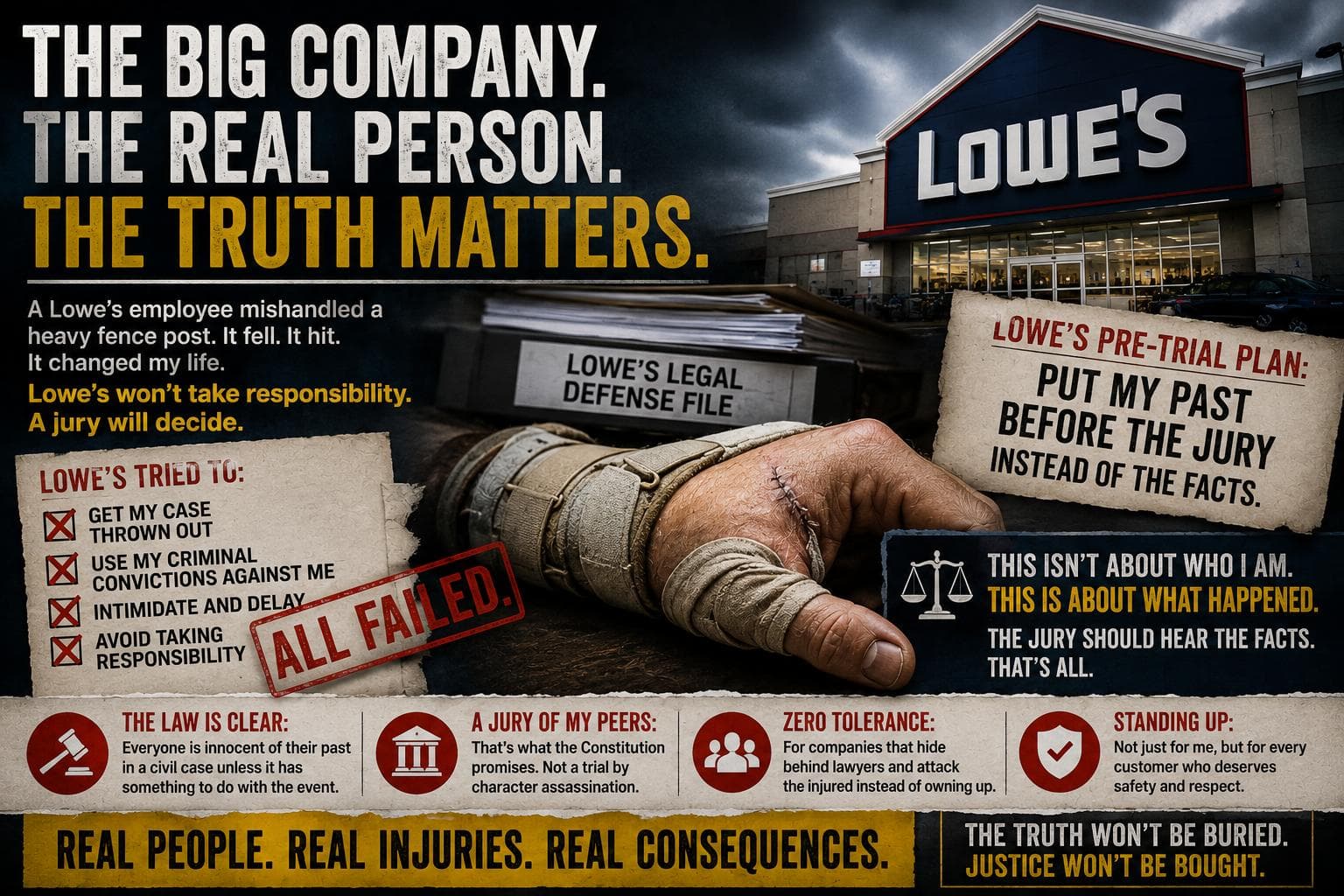
Nathan Reardon alleges that he was injured in the checkout area of the Lowe's store in Brewer, Maine, in December 2019 when a cashier mishandled a wooden fence post. According to the court record, the post fell toward Reardon, he reached to catch or deflect it, and it struck his thumb. Lowe's disputes negligence, medical causation, and damages.
Unlike many customers facing a major corporation, Reardon is not represented by a law firm. Lowe's is represented by experienced outside counsel from Morrison Mahoney LLP. Yet the case has survived Lowe's attempt to dispose of it before a jury could hear the evidence.
First: Try to End the Case
Lowe's moved for summary judgment. A central defense argument was that Reardon had not disclosed his own medical expert and therefore could not establish medical causation for the injuries and treatment he attributes to the incident.
On July 28, 2026, U.S. District Judge John A. Woodcock Jr. denied Lowe's motion. The court concluded that a factfinder could determine that the Lowe's employee fumbled the wooden fence post, that it struck and damaged Reardon's thumb, and that he sustained at least some compensable injury. The court left for trial the boundary between injuries that may be understood through common sense and more complex medical-causation questions requiring expert testimony.
That ruling did not establish final liability and did not guarantee any damages award. What it did was preserve the case for trial — and only part of it. The court was explicit that what survives on common-sense causation alone is "the immediate consequences of the injury, namely pain in his thumb." Whether the incident also caused Reardon's later tendon surgery is a separate, unresolved question. Lowe's own expert, orthopedic surgeon Dr. Bruce M. Leslie, has opined that the injury documented in Lowe's own video footage was not consistent with the kind of tear that would require surgery, and that the surgery was more likely caused by a chronic condition unrelated to the incident. That dispute, unlike the thumb-pain question, may turn on expert testimony Reardon has not offered.
Then: Put the Plaintiff's Criminal Record on the Trial List
With summary judgment unsuccessful, Lowe's filed its September 1, 2026 Pre-Trial Memorandum. In that filing, Lowe's listed witnesses it may use to authenticate Reardon's prior criminal convictions and identified copies of those convictions as potential trial exhibits for impeachment under Federal Rule of Evidence 609.
Those convictions do not determine whether a Lowe's employee mishandled the fence post or whether the post struck Reardon's thumb. Lowe's is invoking a separate evidentiary rule aimed at credibility. Whether any particular conviction may actually be shown to the jury is for the court to decide.
Reardon is seeking to exclude or tightly limit that evidence. The dispute creates a sharp contrast in the case: a negligence lawsuit centered on what happened inside a Lowe's checkout area may now include a fight over how much of the plaintiff's unrelated criminal history the jury should be allowed to hear.
A Familiar Corporate Defense Move: Summary Judgment
Lowe's is fully entitled to contest lawsuits against it. But Reardon's case is not the only injury action in which the company has asked a court to dispose of a customer's claim before trial and failed.
Hendrickson v. Lowe's
In a 2016 Nevada trial, a jury awarded more than $16.4 million to customer Kelly Hendrickson after finding Lowe's 80% at fault for a fall in water in a garden department. The reported award included medical expenses, pain and suffering, and future pain damages.
Galassi v. Lowe's
A customer alleged that improperly shelved wire fencing fell and broke her toe. Lowe's won summary judgment in the trial court, but the Washington Court of Appeals reversed. In 2025, the Washington Supreme Court affirmed that reversal and sent the case back for further proceedings.
Easter v. Lowe's
In Louisiana, a customer alleged that a faucet display board tipped forward and landed on her shoulder. Lowe's sought summary judgment. In April 2026, the federal court denied the motion.
Goldin v. Lowe's
In South Carolina, plaintiffs brought negligence, gross-negligence, and recklessness claims against Lowe's. In March 2026, the federal court denied Lowe's motion for summary judgment.
These cases involve different facts, different states, and different legal standards. They do not prove Lowe's is liable in Reardon's case. They do show something narrower and verifiable: Lowe's has faced significant adverse outcomes in customer-injury litigation, including a multimillion-dollar jury verdict and multiple unsuccessful attempts to obtain summary judgment.
The Timeline
What Happens Next
The central questions remain for trial: whether Lowe's was negligent, what injury the incident caused, and what damages — if any — should be awarded. Lowe's intends to use surveillance video, medical evidence, and orthopedic expert Bruce M. Leslie, M.D. Reardon intends to present his own evidence concerning the incident, his hand injury, and its effect on his ability to perform skilled mechanical work.
A federal jury may ultimately accept Lowe's defense, accept Reardon's case, or reach a result somewhere between the two. But one avenue has already closed: Lowe's did not succeed in ending the entire case through summary judgment.
Source Record
Order on Motion for Summary Judgment, Reardon v. Lowe's Home Centers, LLC, Case No. 1:25-cv-00099-JAW, filed July 28, 2026.
- U.S. District Court, District of Maine, Reardon v. Lowe's Home Centers, LLC, Case No. 1:25-cv-00099-JAW, Order denying summary judgment, July 28, 2026.
- Defendant Lowe's Home Centers, LLC's Pre-Trial Memorandum, ECF No. 53, filed Sept. 1, 2026.
- Courtroom View Network: Hendrickson v. Lowe's Home Centers LLC.
- Washington Supreme Court: Galassi v. Lowe's Home Centers, LLC.
- Easter v. Lowe's Home Centers LLC — order denying summary judgment.
- Goldin v. Lowe's Home Centers, LLC — order denying summary judgment.